


;Resize,width=570;)
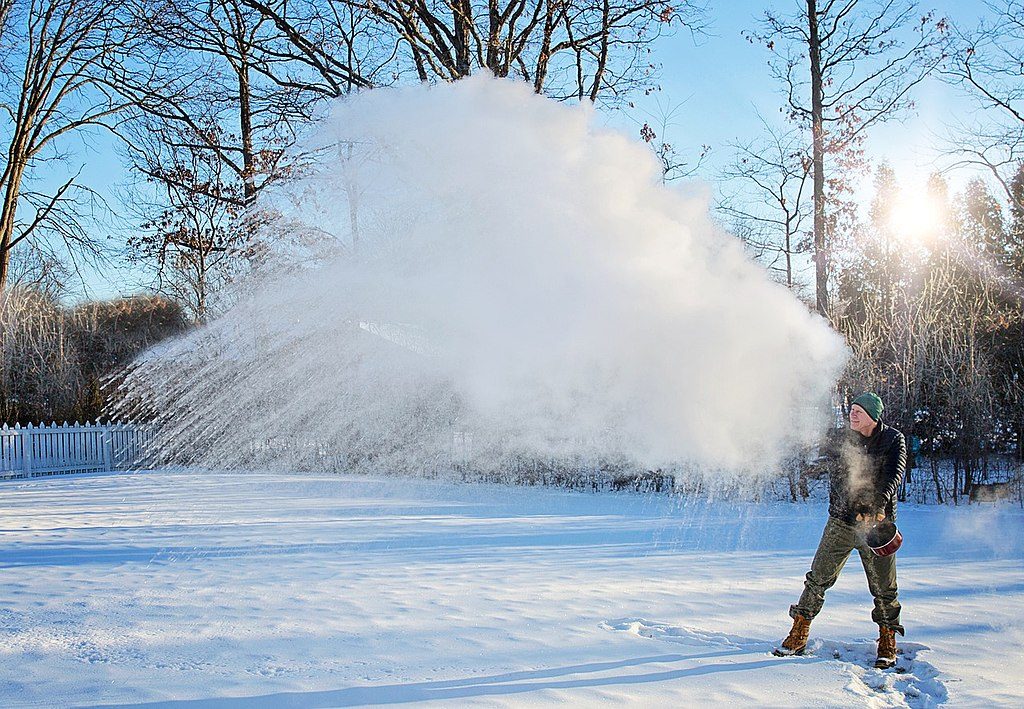
We all know that water freezes at 0 °C under normal conditions. But how long does it take? We might think that the warmer the water, the longer it takes to freeze. In reality, this is not the case: hot water freezes faster than cold water. This completely counterintuitive phenomenon is known as the Mpemba effect. Although Aristotle already described it and it is so replicable at home or outside on a cold winter’s day, his scientific studies only began in 1969. Since then, however, despite our best efforts, we still do not have a definitive explanation for this strange phenomenon. The story of this physical mystery begins with a high school boy in Tanzania busy making ice cream. Let’s look at it together and review the hypotheses that are in vogue to explain this strange phenomenon.
The discovery of the Mpemba effect
The L’Mpemba effect derives its name from the observation of Erasto Mpembathen a high school student in Magamba, Tanzania. IN 1963during a cooking activity at school in which the class prepared portions of ice creamMpemba put his mixture in the freezer while it was still boiling while his companions let him cool down to room temperature: at the end of the lesson was his compound already frozen while his companions were not yet there.
With this, Mpemba later asked a British physicist to explain this phenomenon Dennis Osborne, a professor at the University of Dar es Salaam, when he came to lecture at his secondary school in Iringa town. Despite his initial misgivings, Osborne did he repeated the experiment, confirming the phenomenon. Subsequently, the student and professor jointly published in 1969 scientific article titled Cold? in the magazine Teaching Physics.

It should be taken into account that, although until the article by Mpemba and Osborne, no one has ever studied it systematically, the phenomenon has already been noted since ancient times. They talked about it, for example, Aristotle in his treatise on meteorologicals but also the natural philosopher Francis Bacon and philosopher Descartes. It is therefore a phenomenon that has been known for some time, even if only a few years ago the explanations were non-scientific.
Since the publication of the 1969 paper, many physicists have debated whether this effect exists real or because of experimental errors. But even those who are convinced of its existence are still looking for it explanation of this phenomenon counterintuitive. Some have been identified over the years hypothesis, but none have yet been fully considered satisfying in all situations.
Why hot water freezes before cold water: a possible explanation
Although it may seem like a simple phenomenon, freezing – and all state transitions in general – is very complex when analyzed at the molecular scale. Many scientists have tried to explain the possibility of the Mpemba effect and the hypothesis ranges from several trivial to those more complex.
Evaporation
The simplest explanation is evaporation: hot water evaporates quickly, reducing the amount of water in the container and therefore the freezing time.
Heat transfer
Evaporation is a process that removes heat from a body of water, shortening the time it takes for the water to freeze.
Flowing
Hot water has faster convective currents inside, which improve heat exchange with the outside environment and thus shorten the freezing time.
Dispersion of frost cores
A high rate of convection could also disperse the frost cores around which the water freezes more evenly, promoting faster freezing.
Heat insulation
Again, due to convection currents, warm water is less likely to form a frozen layer on the surface that thermally insulates the rest of the water mass.
Release of dissolved gases and precipitation of dissolved substances
Heating the water can induce the release of dissolved gases or the precipitation of solutes in the liquid, thereby reducing the freezing nucleation and thus causing the water to freeze earlier.
Superfusion
The phenomenon of superfusion occurs when the liquid has a temperature lower than the solidification temperature, but is unable to perform a change of state, for example, due to the absence of solidification nuclei or the difficulty of correctly orienting the molecules to integrate into the crystalline structure of the solid: this slows down the rate of solidification of the liquid. Due to convection currents and a lower presence of impurities, hot water is less subject to hypothermia and therefore freezes faster.
Hydrogen bonds
The last and most complex hypothesis has to do with the hydrogen bonds that form inside liquid water: bonds that are weaker than those that bind atoms inside molecules and molecules inside solids but are strong enough to give water its special chemical nature. -physical properties (melting point, boiling point, viscosity, surface tension). The presence and strength of hydrogen bonds change with temperature and may be one reason why hot water freezes faster.
The importance of looking through the eyes of science
Although no complete explanation of the phenomenon has yet been found that fully fits all situations, the Mpemba effect is a demonstration that Science is both rare and fascinating in everyday life as the view of reality through the eyes of science always shows us peculiarities AND curiosity just waiting to be discovered.

