


Explore Maxwell’s extraordinary performance that propelled Australia to a stunning T20I series win against South Africa. Read the full story and highlights!
Introduction:
In a contest that distilled the drama and unpredictability of T20I cricket, Australia emerged victorious against South Africa in the series decider at Cairns, thanks to a spectacular unbeaten 62 from Glenn Maxwell, steering them home by two wickets with a solitary delivery left in the match. The showdown between Maxwell’s flair and Corbin Bosch’s incisiveness produced a memorable night at Cazaly’s Stadium, filled with pulsating tension and moments destined for highlight reels.

Intense Beginnings and a Venue’s Unique Aura
Cairns welcomed both sides under the North Queensland floodlights, serving as the setting for a winner-take-all clash with the series locked at 1-1. Mitchell Marsh, Australia’s captain, opted to bowl after winning the toss, a decision shaped by his squad’s desire to understand the characteristics of the surface with limited prior exposure. The venue’s intimacy, paired with a lively local atmosphere, infused the evening with energy. Marsh described Cairns’ pre-match as “an amazing part of Australiaâ€, alluding to both the physical beauty and the sense of occasion for cricket in regional venues.
The teams made strategic adjustments. Australia handed paceman Nathan Ellis a recall for Sean Abbott, Josh Inglis returned after illness, and Aaron Hardie replaced Mitch Owen, out with a concussion. South Africa’s skipper Aiden Markram acknowledged he’d have preferred to bat first, but with Senuran Muthusamy coming into the XI, he emphasised adaptability and a strong batting platform. See also: Brevis Masters the Moment: South Africa’s Youngest Centurion
Brevis’ Blitz and South Africa’s Aggression
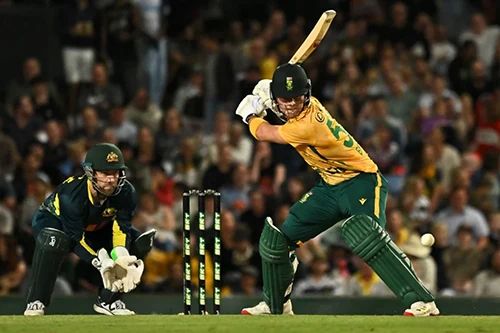
South Africa’s innings sparked into life thanks largely to Dewald Brevis, who carved out 53 from 26 balls—a knock constructed with breathtaking audacity, featuring clean hitting and rapid run gathering. Batting at No.4, “Baby AB†lived up to his moniker, launching the ball to all corners and unsettling the Australian bowlers during the powerplay and beyond.
Australia seized breakthroughs early through Josh Hazlewood and Adam Zampa, who accounted for Markram and Rickelton, but Brevis, supported by Tristan Stubbs and Rassie van der Dussen, kept South Africa’s momentum alive. The away side managed a brisk progression through the middle overs, benefiting from subtlety in shot selection and the ability to capitalise on the short boundaries.

Nathan Ellis, recalled specifically for his death overs expertise, delivered three vital wickets—changing the complexion of the South African innings just as they eyed a total close to 190. South Africa finished at 172/7, a score that seemed competitive on a pitch with signs of uneven bounce but plenty of run-making opportunities under the lights.

Australia’s Chase: Marsh and Maxwell Take Centre Stage
Australia’s chase got off to a brisk start, with Travis Head and Mitchell Marsh putting on a quickfire partnership. Marsh, the captain, combined composure with power, notching up a crucial 54 that kept Australia ahead of the rate even as wickets began tumbling. South Africa fought back through Corbin Bosch, whose 3/26 wrecked Australia’s middle order, sending Josh Inglis, Head, and Cameron Green back relatively cheaply just as the hosts looked set for a smooth passage to victory.

Bosch’s spells, particularly his success in breaking partnerships amid mounting pressure, brought echoes of classic T20I climaxes—when one bowler’s initiative swings the game dramatically. Kagiso Rabada and Kwena Maphaka lent further discipline, picking up wickets and increasing the required rate.
As wickets fell in clusters and the equation ballooned—10 needed off the last over, with only two wickets in hand—the contest seemed to tilt towards South Africa. Yet Maxwell, with his typical panache and fearless approach, picked the moment to stamp his authority.

Maxwell: Match-Winner Extraordinaire
Glenn Maxwell’s innings was vintage “Big Showâ€â€”built on innovation, counterattack, and stunning clarity under pressure. Arriving amid a wobble with Bosch’s third wicket threatening a collapse, Maxwell orchestrated his chase in calculated bursts. He blended wristy strokes with bursts of power, unfurling reverse sweeps and late cuts before upping the ante in the closing overs.
Maxwell reached his half-century with two overs left, the tension palpable as the equation narrowed. In the final over, delivered by Kagiso Rabada, Maxwell first found the boundary, then, with two needed off two balls and only the number eleven for company, he reverse-scooped a full delivery straight into the stands—a shot emblematic of his style, audacity, and match awareness.

His unbeaten 62 off 36 balls, featuring eight fours and two sixes, rescued Australia from the brink and clinched the game, the series, and the adulation of the Cairns crowd. Maxwell left the field saluted by teammates and fans alike, his performance a testament to his stature as a clutch performer in T20 cricket—a player described as “inconsistent but worth the gamble,†fitting for the game’s frenetic format.
Bosch, Brevis Shine Despite Defeat
For South Africa, the narrow defeat was bitter, having orchestrated a mid-innings fightback and brought the match to the edge of victory. Bosch’s figures—3 for 26—reflect his ability to deliver at crucial moments, taking responsibility amid pressure and firing up his teammates. His mix of yorkers and slower balls made him the standout bowler, while Brevis’ batting kept the contest competitive until Ellis’ death-overs mastery.

South Africa’s bowling attack, featuring Rabada and Ngidi’s pace, Maphaka’s youthful verve, and Markram’s tactical nous, showed depth. Yet the inability to counter Maxwell at the denouement meant the tour ended with another “so near yet so far†feeling—a familiar refrain for SA fans in recent ICC cycles.
Strategic Contests and Psychological Battles
The Cairns decider highlighted strategic contests integral to modern T20I cricket:
Marsh’s decision to bowl first in unfamiliar conditions, seeking to exploit dew and chase strengths. Ellis’ death-over spells, contrasting with Australia’s risk in rotating bowlers amid scoreboard pressure. Markram’s adaptive field settings and Bosch’s attacking lengths as wickets fell.

Psychological battles abounded, with Australia’s camp staying calm after a flurry of wickets, relying on Maxwell’s experience rather than panicking. South Africa, repeatedly on the brink of triumph, saw fielders rally and bowlers scheme, yet were unable to land the knockout blow.
The Atmosphere, Emotions, and Series Narrative
The crowd at Cazaly’s soaked in a night of high-octane cricket, the see-sawing action keeping all invested until nearly midnight. Local fans roared with every boundary and wicket, lending Cairns the air of an international fortress for one night. Such regional matches grant Australian cricket a sense of national unity, away from the usual big city venues.
Both squads showed visible exhaustion and emotion at the finish. Marsh praised Maxwell’s “fearlessness and clarity,†Bosch lamented the missed final chance, and Brevis reflected on “being part of a match that could have gone either way.â€
With the series ending 2-1 in favour of the hosts, the T20 leg wrapped up with anticipation around the ODI series to come. For Australia, this marked a key boost in preparation for the summer. For South Africa, learnings from a narrow loss would fuel their ODI ambitions, with discussions centering on the need for a finisher and tighter execution in tense moments.
Final Reflections: Cairns’ Classic
The Australia vs South Africa, 3rd T20I at Cairns, will linger as a classic—featuring explosive batting, smart bowling, and a finale worthy of a blockbuster. It showcased the drama and unpredictability that continues to define international cricket.
Maxwell’s brilliance and South Africa’s grit joined to script a match that could have gone any direction until the very last ball. Maxwell reminded the cricketing world of his box-office appeal, while South Africa underlined their credentials as dangerous opponents. Ultimately, the difference lay in the details—a single run, a late boundary, and a player for the biggest stage.
With the crowd streaming out and players exchanging handshakes, this Cairns decider left behind legends-in-the-making and stories to be retold for summers to come.

